

Two Progressive-Era Sisters from Nebraska – Why Their Work Matters Now
Edith and Grace Abbott, two sisters from Nebraska, helped establish formal protections for children and developed early public programs for families facing economic insecurity.
They challenged a system that treated children’s labor as a financial necessity.
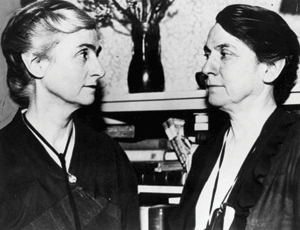
Edith (left) and Grace Abbott
Edith (1876–1957) and Grace (1878–1939) Abbott, born just two years apart in Grand Island, Nebraska, laid the foundation for social services, shaped federal policy, and formalized professional education. They took different professional paths, but they shared a clear philosophy: that research, public policy, and practice must work together to address poverty and inequality. Their approaches were deliberately complementary. Together, they were far more powerful than either would have been alone.
In the early twentieth century, both made their way to Chicago, where rapid immigration, industrialization, and deep inequality were reshaping the city. Hull House, founded in Chicago in 1889 by Jane Addams and Ellen Gates Starr, had become a center for research, reform, and action. Edith and Grace were drawn into this movement and played a central role in building its momentum.
Edith Abbott became a scholar and institution builder. She believed lasting change required rigorous research, strong training programs and credible public institutions. At the Chicago School of Civics and Philanthropy — now the Crown Family School of Social Work, Policy, and Practice — she helped establish social work as a profession grounded in evidence and accountability. In 1924, she became the first woman to serve as dean of any graduate school in the United States.
Working within the government, Grace Abbott focused on translating research and personal experience into policies that could reach families at scale. In 1921, Grace became chief of the U.S. Children’s Bureau, where she led national efforts to enforce child labor laws, improve juvenile courts, and strengthen protections for immigrant children and families. The sisters understood the dynamism of their unique strengths. Edith once reflected,
“I could assemble the facts and write the report. Grace had the gift of applying the proper legislative remedy.” – Edith Abbott
Grace’s work was often controversial. She faced resistance from lawmakers who believed women had no place in shaping national policy. At one point, a U.S. senator dismissed her and her colleagues as “female celibates,” arguing that instead of advancing infant-mortality legislation, they should be encouraged to marry and have children. Grace persisted despite these odds, and the policies advanced.
During the Great Depression, Grace Abbott helped shape child‑welfare and family‑assistance funding in the landmark Social Security Act of 1935. This act was an expansion of the federal safety net; it initially excluded agricultural and domestic workers, and later amendments broadened coverage.
Frances Perkins, Secretary of Labor under President Franklin Roosevelt, captured Grace’s approach simply:
“Grace Abbott put herself in direct contact with poverty and trouble, letting her own experience show her what needed to be done. And then she did it.” – Frances Perkins
Grace died in 1939, at the age of 60. Edith lived nearly two more decades, continuing to teach, write, and advocate, ensuring that their shared work would endure.
The Abbott sisters offer an early and powerful example of something the social sector still strives for today: a deliberate approach to reform that bridges research, practice, and policy. Together, they advocated for workers, immigrants, and children — people who held little political power and few protections.
More than a century later, the foundation they established is still being tested. In January 2026, the federal government attempted to freeze approximately $10 billion in childcare and family assistance funding across five states, including Illinois. A federal judge issued a preliminary injunction in February 2026 to keep the funds flowing while the case proceeds. Moments like this are exactly why their work is still relevant today.
At Alford Group, the Abbott sisters’ legacy resonates deeply. Our work sits at the intersection of theory and practice, informed by research, data, and the lived expertise of nonprofit leaders. Our values of Equity-Centered Practices and Continued Learning reflect the very principles Edith and Grace advanced more than a century ago. We are honored to partner with and support our Human Service Clients, many of which were founded during the early 20th century.
This Women’s History Month, Edith and Grace Abbott remind us that progress is neither inevitable nor permanent. Rather, progress requires people who co‑design, defend, and sustain public systems — especially when those systems are under threat from rising inequity, shifting policy priorities, and shrinking public investment.
Whose work are you standing on — and do you know their name?
Credit to:
Our client Greater Grand Island Community Foundation
John Sorenson
https://www.pbs.org/wnet/americanmasters/grace-abbott-social-work-pioneer-xphseo/13763/
https://www.gilibrary.org/page/abbott-sisters-project/
Grand Island Public Library

Jill Zimmerman
Vice President, Alford Group
Jill Zimmerman is a senior nonprofit executive and consultant with more than 30 years of experience strengthening mission‑driven organizations. A graduate of the Crown Family School of Social Work at the University of Chicago, she partners with leaders to advance equity, deepen community impact, and build sustainable organizational capacity.

Elena Lynch
Consultant, Alford Group
Elena Lynch is a nonprofit consultant with expertise in evaluation, research, and organizational development. She helps mission‑driven organizations use data, learning, and community insight to strengthen programs and expand their impact.